Terrazzo
Terrazzo is not a stone but a composite: chips of marble, granite, quartz or glass set in a binder and ground back to a flat surface so the chips read as part of the surface rather than as inclusions in it. Cement and epoxy are the two binders that matter. Cement gives a matte, chalky, UV-stable surface that takes polish; epoxy gives a thin, non-porous, more saturated one that does not need sealing. The choice of binder decides the thickness, the colour range, the price and how the piece ages.
Cut to order. Terrazzo is a material we cut, and there are no terrazzo pieces in the collection to list here. The block is chosen with you, photographed before cutting, and quoted against your size.
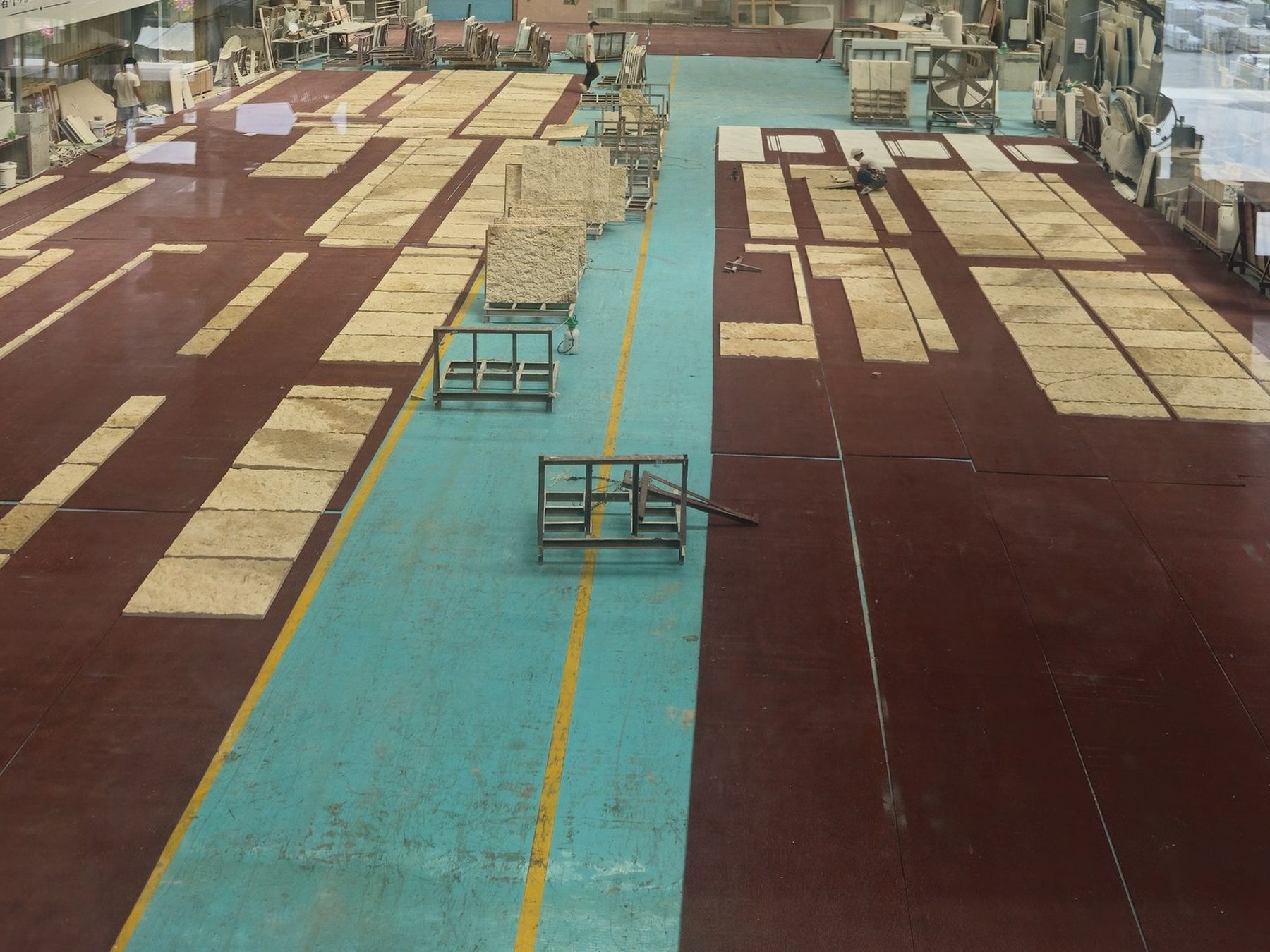
This is our stone floor in Shuitou. A terrazzo top does not come off a block — it is cast from chips — so a terrazzo piece starts in the mould, not on this floor.
What the material is
Terrazzo, in substance
The material is an Italian word for terrace, and the technique goes back to Venetian workshops that ground marble offcuts into a cement-bound facing. Modern terrazzo is made the same way with better control: aggregate is graded and sorted by colour, mixed with pigment and a binder, cast or vibrated to remove air, cured, then ground with diamond tools to expose the chips and polished in stages. Cement-bound terrazzo cures slowly, over days, and remains porous enough to need sealing. Epoxy-bound terrazzo sets in a day or two, is thinner, and is non-porous. Because the chip content can be specified, two pieces in the same material are never identical — which is the case for choosing it and the reason it cannot be ordered from a swatch.
What we can say about it
The figures, and where they come from
These are published values for the material as a type. The limits of each one are stated underneath.
| Binders | cement or epoxy Cement: matte, UV-stable, porous, needs sealing. Epoxy: thin, non-porous, more colour. |
|---|---|
| Epoxy cure | about 24 to 48 hours Cement-bound material takes days to reach handling strength. |
| Typical aggregate | marble, granite, quartz, glass The chip mix is the design. It is chosen per piece, not per catalogue. |
| Recycled content | often 70 to 90% Terrazzo is largely stone offcuts and post-consumer glass. It is a trade figure, not our own. |
Sources. Terrazzo industry literature on cement-bound and epoxy-bound systems; Published processing data on curing times and surface preparation; Standards and specification literature for terrazzo as a surface material.
What this page does not cover
Where we stop, and why
These are the limits of what is written above, stated so nothing here has to be taken on trust.
- We do not publish a chip-to-binder ratio, a thickness or a colour range for our own terrazzo, because the mix is specified per piece with the buyer and we would be quoting a specification we have not made.
- The recycled-content figure is the figure the industry publishes for terrazzo as a product category. We have not audited the content of any specific batch we have been offered.
- Whether a cement-bound piece needs sealing, and how often, depends on the binder and the aggregate. We will say which one a given piece is.
Where it earns its place
The forms of furniture this material suits
Each of these is a form we cut. The block is chosen with the buyer and photographed before cutting.
- Kitchen and bathroom tops where a poured material with no joint pattern reads better than a slab
- Bar counters and reception desks — the chip pattern carries at a distance and hides wear
- Landing tables and console tops, where the material is the whole point of the piece
- Projects that want a specified aggregate mix rather than a named stone
Questions about this material
What we are asked about terrazzo
The answers that cover it.
Terrazzo for Furniture: What You Are Actually Buying
Terrazzo is not a stone but a composite — chips of marble, granite, quartz or glass set in a binder. The binder decides almost everything: thickness, colour, weight, whether it needs sealing and how it wears.
The Nine-Item Brief for Specifying a Stone Furniture Project
The nine things to specify before a stone furniture project can be drawn and quoted — use, dimensions, stone, thickness, edge, base, cut-outs, fittings and delivery.
Marble Edge Profiles for Furniture: A Cost and Safety Comparison
The six marble edge profiles for furniture compared — eased, bevel, bullnose, ogee, mitred and waterfall — on appearance, relative cost, chipping risk, child safety and slab thickness compatibility.
Ask for a price
Tell us the size and the finish
A quote needs the size, the finish and the delivery address. We photograph the block before cutting and send the photographs for approval, so what arrives is what you approved.