Gemstone
In the stone trade, gem stone means the ornamental and semi-precious materials sold in slab form for furniture and interiors — agate, amethyst, malachite, tiger's eye, lapis, jasper, petrified wood and the rest — not the small polished pieces a jeweller cuts. Most of what reaches a furniture job is slab material: a crystal or a fossil, bonded and polished, and often translucent enough to light from behind.
Cut to order. Gemstone is a material we cut, and there are no gemstone pieces in the collection to list here. The block is chosen with you, photographed before cutting, and quoted against your size.
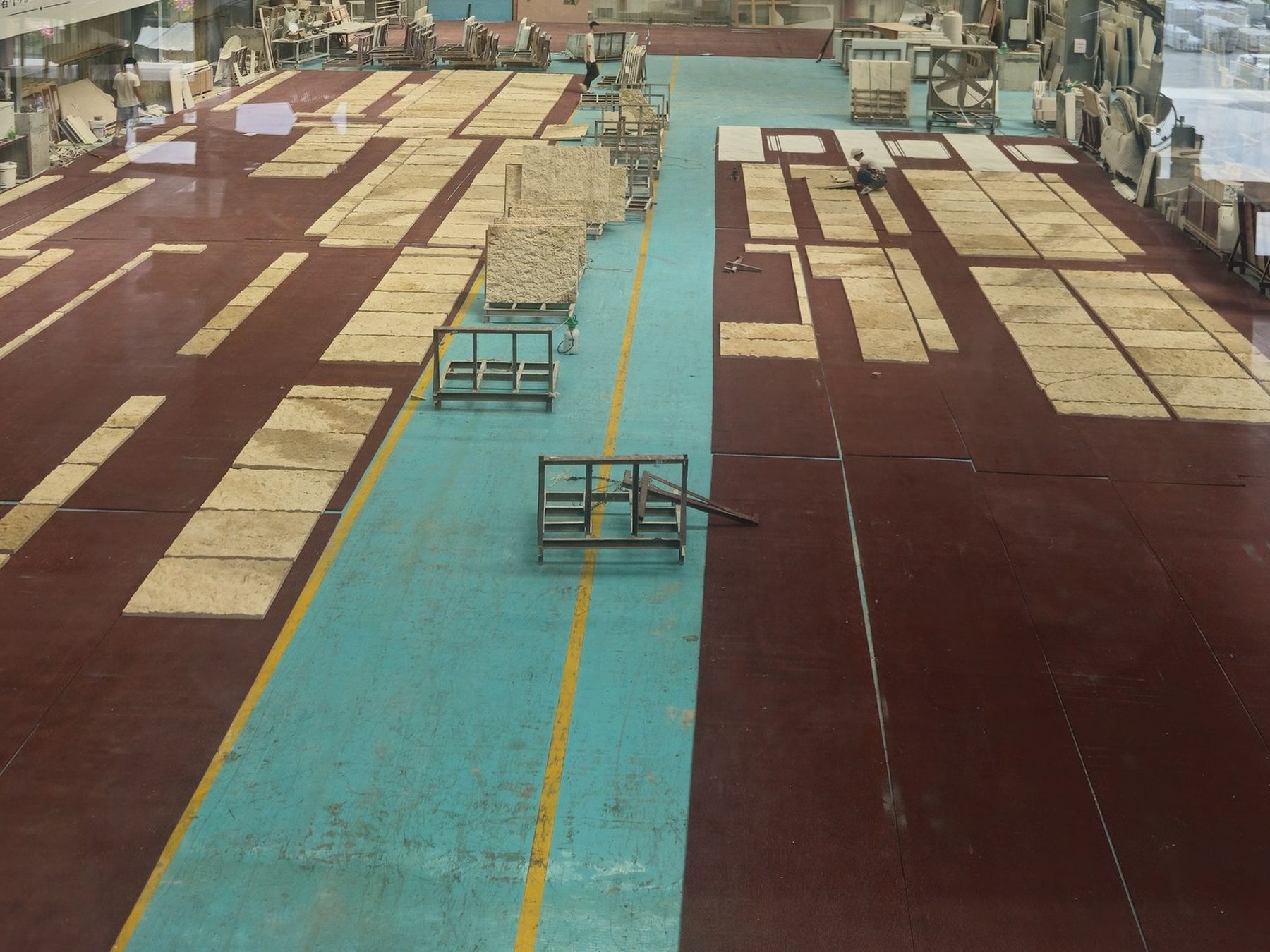
This is our stone floor in Shuitou. The gem stones on this page are cut to order, so the block is chosen with you and photographed before it is cut.
What the material is
Gemstone, in substance
The materials in this family are used the way stone is used, at architectural scale, which is a different proposition from jewellery. Agate and amethyst are read as banding and colour; malachite as swirled green; tiger's eye as chatoyance, a shifting shimmer that moves with the light. Petrified wood is fossil timber that was buried and replaced by silica and quartz over millions of years, so the original grain and growth rings are still legible in a polished surface. Most suppliers sell these as slabs: natural chips and slices set in epoxy or resin, which makes them thin, seamless and non-porous, so they do not need sealing. Because they are translucent, they are the usual choice when a piece has to glow rather than merely be hard. This is a different trade from the one architectural onyx and jade belong to, and the pages for those say so.
What we can say about it
The figures, and where they come from
These are published values for the material as a type. The limits of each one are stated underneath.
| Typical materials | agate, amethyst, malachite, tiger's eye, lapis, jasper, petrified wood The list is not a range. Each piece is chosen for its own pattern. |
|---|---|
| Common thickness | 10 to 30 mm Slab material is usually supplied in this range. A furniture top can be built up on a base. |
| Porosity | none when epoxy-bound A resin-bound slab is non-porous and needs no sealer. |
| Translucency | varies by material Agate, quartz and calcite transmit light; malachite and lapis mostly do not. |
Sources. Gem and semi-precious stone slab suppliers' published material descriptions; Published data on slab thickness and resin-bound fabrication; Interior design press on the use of ornamental stone in furniture.
What this page does not cover
Where we stop, and why
These are the limits of what is written above, stated so nothing here has to be taken on trust.
- We do not publish a translucency value, a weight or a hardness figure for a gem material, because each one is a different mineral. A figure for one would say nothing about the next.
- Petrified wood slabs vary enormously in how the fossil structure falls. The cutting area is agreed with the buyer on the actual slab before the piece is made, because where the rings land is the whole design.
- The gem trade does not grade furniture slabs the way it grades a stone for a ring. We do not claim a grade for any material here.
Where it earns its place
The forms of furniture this material suits
Each of these is a form we cut. The block is chosen with the buyer and photographed before cutting.
- Backlit panels and bar fronts, where the material is chosen for what it does with light
- Statement tops — coffee tables, console tops, side tables — where the pattern is the piece
- Inlay and mosaic detail in a marble or onyx top
- Objects and small-format pieces, where the material is cut rather than slabbed
Questions about this material
What we are asked about gemstone
The answers that cover it.
Gem Stone for Furniture: What the Trade Means by It
In the stone trade, gem stone means ornamental and semi-precious material sold in slab form for furniture and interiors — agate, amethyst, malachite, tiger's eye, petrified wood. It does not mean jewellery, and it is not the same thing as architectural onyx.
Onyx Stone Explained: Architectural Onyx, Not the Gemstone
What architectural onyx actually is — banded calcite, its Mohs hardness, absorption and density, where it comes from, and why it needs backlighting to be worth the price.
How to Choose a Marble Table: Nine Questions to Ask
Nine questions to settle before buying a marble table — slab thickness, size against the room, edge profile, weight, finish, base and stone choice, answered directly.
Ask for a price
Tell us the size and the finish
A quote needs the size, the finish and the delivery address. We photograph the block before cutting and send the photographs for approval, so what arrives is what you approved.